A district that lives from craftsmanship
Walk south across the Ponte Vecchio and you enter the Oltrarno, literally “beyond the Arno”. Here lie the Palazzo Pitti and the Boboli Gardens, but also the districts of Santo Spirito, San Frediano and San Niccolò, in whose lanes people have worked for centuries. The official Italian tourism portal lists goldsmiths, engravers, bookbinders, marquetry makers, glass artists and leather craftspeople for Santo Spirito and San Frediano. The tourism portal of the Tuscany region adds gilders, silver chasers, ceramicists and wood carvers, and names Via Maggio as the street of the antique dealers.
Unlike in the shopping streets around the cathedral, here you often see the workbench behind the sales counter. That is precisely the appeal, and it carries an obligation: whoever steps in here is entering a workplace. The reward is a Florence that does not hang in any museum but is made anew every day.
Start at the southern end of the bridge. To the left is Via de' Bardi, where the workshop Il Torchio has made notebooks, photo albums and books since 1980, also to measure.
On Piazza Pitti, Pietro Giannini founded the bookbindery Giulio Giannini e Figlio in 1856, which today offers workshops in paper marbling. The museum in the Palazzo Pitti is best visited in the morning and the workshops in the afternoon, or the other way round.
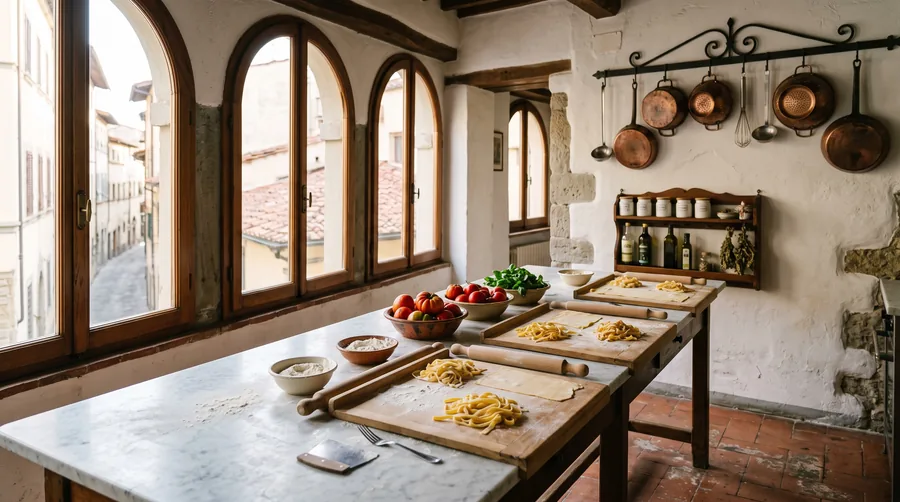
In Via dei Velluti, a few steps from Piazza Pitti, the cooking school In Tavola offers courses in pasta, full menus, and pizza and gelato. This is how to combine the walk with a cooking class.
Via Maggio with its antique dealers takes you to the square with the basilica. In Santo Spirito, workshops gild frames and furniture.
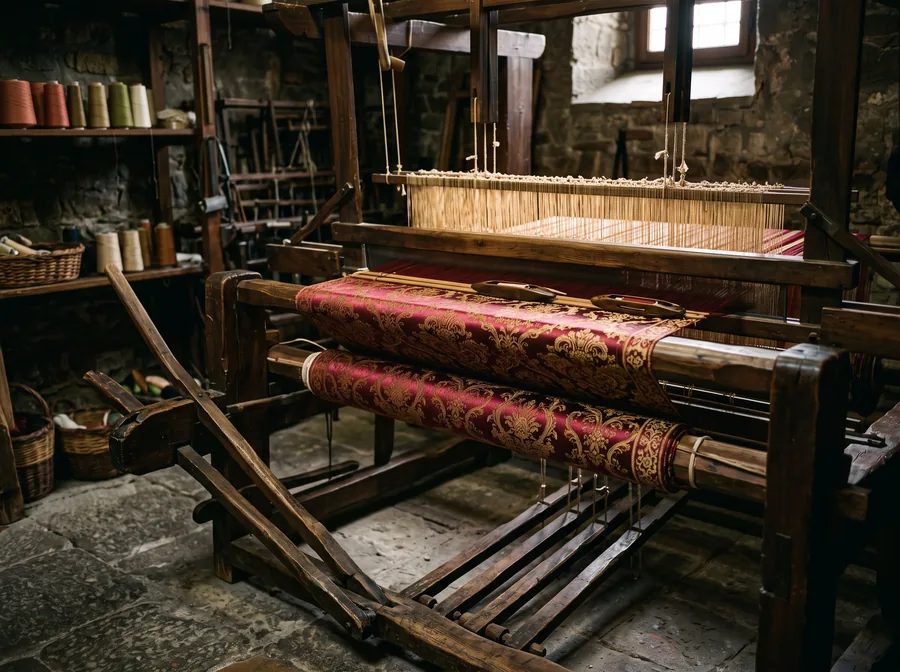
Through Via Santo Spirito and Borgo San Frediano you reach this gate of the old city wall. In the San Frediano district, in Via Lorenzo Bartolini, silk damasks and brocades are produced on old looms at the Antico Setificio Fiorentino.
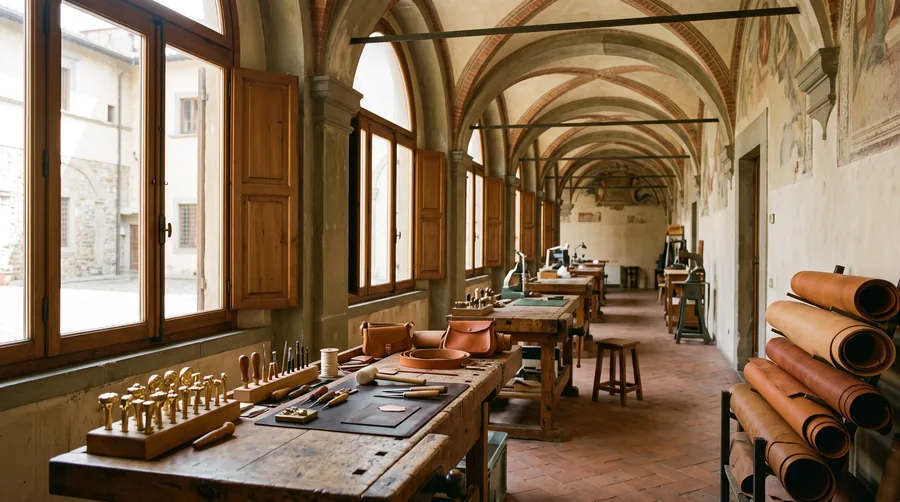
A well-known address for leather, on the other side of the Arno near Santa Croce.
The trades: what you will find in the Oltrarno
- Gilding: In Santo Spirito, workshops gild frames and furniture using a technique that the regional tourism portal traces back to the 15th century. Frames are carved, primed and covered with wafer-thin gold leaf.
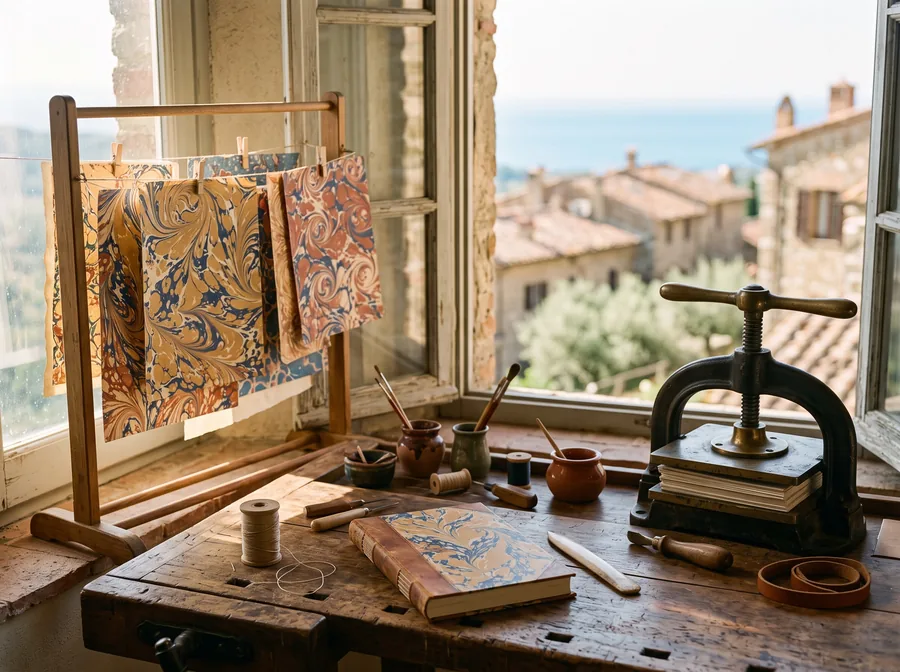
- Bookbinding and marbled paper: Florentine bookbinding works with leather, linen and hand-marbled paper. For this, colours are drawn into patterns on a bath and transferred to the sheet, and no two sheets are alike.
- Gold and silver work: Setting stones, engraving, chasing silver and casting metal by the lost-wax method, all by hand.
- Marquetry and wood carving: Inlay work in wood and carved frames are among the trades that have shaped the district.
- Shoes and leather: Bespoke shoemakers and leather workshops make to order.
- Silk: In San Frediano, historic looms are still running; more on this in the next section.
Three workshops with a history
Giulio Giannini e Figlio was, by its own account, founded in 1856 by Pietro Giannini on Piazza Pitti. The business specialises in artistic bookbinding and hand-decorated paper and offers workshops on its website, from a visit with a marbling demonstration to courses in which you make marbled paper and bind a small book.
Il Torchio in Via de' Bardi, near the Ponte Vecchio, has carried on the Florentine bookbinding tradition since 1980. According to its own website, the workshop works with Florentine leather, hand-marbled papers and coloured linen fabrics and makes notebooks, photo albums and books, also to measure.
The Antico Setificio Fiorentino in Via Lorenzo Bartolini in the San Frediano district traces its history back to 1786. On old looms it produces silk damasks, brocades and lampas to patterns from its own archive. According to the Setificio, its collection includes an 18th-century warping machine built to a design by Leonardo da Vinci. The business supplies interior designers around the world, among others; whether and when visitors can look in, clarify in advance by email.
Visiting respectfully: how to behave
- Greet and ask: A “Buongiorno” on entering and the question of whether you may look around open more doors than any guidebook.
- Photos only with permission: Workbenches, tools and half-finished pieces are working material, sometimes commissions for customers. Ask before you photograph.
- Do not touch: Touch only what is clearly on display for sale, and nothing on the workbench.
- Small groups: Come in twos or threes. Many workshops are so small that five visitors fill the room.
- Appreciate rather than haggle: Handwork has its price. If you buy nothing, thank them for their time.
- Book courses: If you want to learn more, book a demonstration or a course. That way the craftspeople’s time is paid for.
- Mind working hours: Small businesses often close over lunch. Come in the morning or late afternoon, and take it calmly if a door is closed.
What you take home should fit in your suitcase and come from here. A notebook with a marbled cover, a sheet of marbled paper for framing or a leather bookmark are light and typical of the district. For made-to-measure items such as shoes, frames or bound books, ask about lead time and shipping, because good work takes weeks. Have them explain how a piece is made: most craftspeople like to talk about their work when they sense that you are genuinely interested. If you are looking for leather, you will find a well-known address on the other side of the Arno, the Scuola del Cuoio near Santa Croce.
A walk through the district
A tour takes two to three hours without a course. Start at the southern end of the Ponte Vecchio and turn left into Via de' Bardi. Back at the bridge, the route leads along Via Guicciardini to Piazza Pitti and on along Via Maggio, with its antique dealers, to Piazza Santo Spirito with the basilica. From there it goes through Via Santo Spirito and Borgo San Frediano to Porta San Frediano, a gate of the old city wall.
If you would like to combine the walk with a cooking class, you will find the cooking school In Tavola in Via dei Velluti, a few steps from Piazza Pitti, with courses in pasta, full menus, and pizza and gelato. An overview of ceramics, paper and leather across Italy is given in the article Discovering Italian craftsmanship.
Planning: days, time of day, combinations
Weekdays, when the businesses are working, are best for workshop visits; on Sundays many are closed. Combine the district with a museum visit at the Palazzo Pitti, ideally the museum in the morning and the workshops in the afternoon, or the other way round. In April and May Florence also hosts the international crafts fair MIDA, which shows a broad cross-section.
The historic centre of Florence has been on the UNESCO World Heritage List since 1982, and the Oltrarno with the Palazzo Pitti is part of it. If you are fitting Florence into a round trip, plan half a day for the district, as the itinerary Tuscany in seven days suggests. How to order properly in an Italian bar when you need an espresso in between is explained in the article Caffè in Italy.