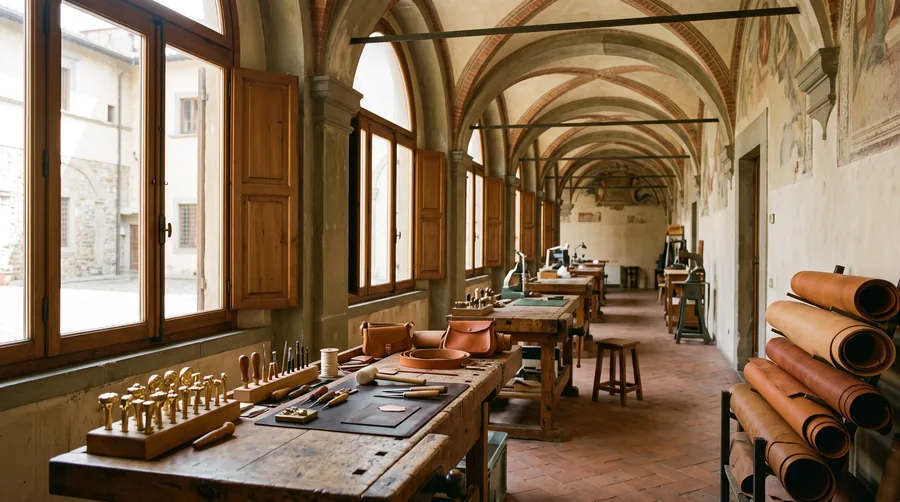
In many Italian towns, craftsmanship is not a shop window for travellers but everyday life. Potters turn plates on the wheel, in Amalfi sheets are made from cotton fibres, in Florence leatherworkers sew bags by hand. If you know where to go and how to behave in a workshop, you see more than the display. This article leads to three crafts in the regions this magazine starts with, explains how to recognise genuine handwork, and how your purchases get home intact.
Vietri sul Mare: ceramics at the gateway to the Amalfi Coast
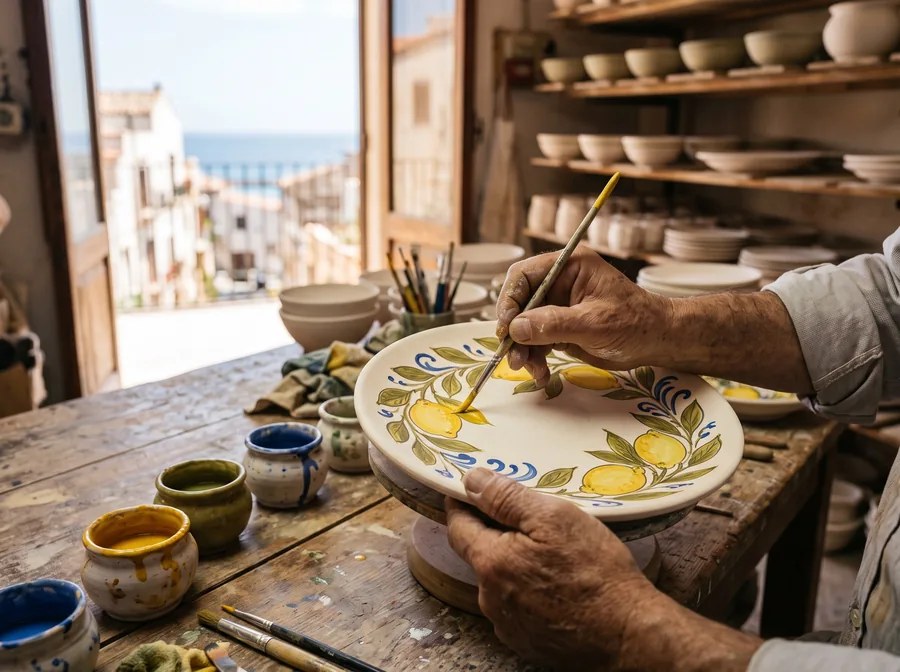
Vietri sul Mare lies at the eastern end of the Amalfi Coast, right next to Salerno. The town has been known for glazed ceramics for centuries, and you can see it in the lanes: many shopfronts are clad in painted tiles, and in the shops plates, jugs and tiles pile up in strong colours.
To understand how the style developed, begin at the Museo Provinciale della Ceramica in the Raito district. It lies in the park of the Villa Guariglia, which the ambassador Raffaele Guariglia gave to the province of Salerno. The collection is divided into three parts: devotional pieces of the 17th and 18th centuries, everyday tableware mainly from the 19th century, and the so-called German period, named after the foreign, mostly German ceramicists who worked in Vietri in the first half of the 20th century. According to the Touring Club Italiano the museum is open all year from Tuesday to Sunday from 9:00 to 15:00, and admission is free; the times may change.
The best-known factory in the town is also an architectural monument: the Ceramica Artistica Solimene. Vincenzo Solimene, whose family has worked with ceramics for more than a century, had the architect Paolo Soleri design a new factory in 1951, which was completed in 1954. According to the company, tableware, floor and wall tiles are made there entirely by hand, shaped on the potter's wheel and painted by hand.
Amalfi: paper from the Valley of the Mills
Behind Amalfi the Valle dei Mulini, the valley of the mills, stretches into the mountains. Here the Canneto stream drove the machines of the paper mills through underground channels. The Museo della Carta cites historians according to whom papermaking in Amalfi goes back to the 13th century; even then there is mention of Bambagina, a paper whose name points to cotton. Around 1700, according to the museum, eleven paper mills worked in the town. The flood of November 1954 destroyed most of the businesses: of the sixteen still producing at that time, three remained.
The museum itself stands in an old paper mill, whose origins it dates to the 13th century. On view are wooden hammers which, driven by a water wheel, beat rags to a pulp, stone vats, presses from the 18th century and a so-called Hollander beater, a grinding machine which, according to the museum, was installed on 18 November 1745. On the guided tours the restored machines run on the water of the Canneto, and visitors can make a sheet themselves. The museum shop sells handmade paper from Amalfi.
One of the paper mills that still produce today is the Cartiera Amatruda on the same road, about a hundred metres beyond the museum. It cannot be visited, however: the company gives lack of space and safety regulations as the reason and itself refers interested visitors to the museum. Paper goods from the mill are sold by retailers that the company lists on its website, and by its own online shop.
The town has been known for glazed ceramics for centuries. The Museo Provinciale della Ceramica in the Raito district shows the history of the style, and the Solimene factory works in a building by Paolo Soleri.
In the valley of the mills stands the Museo della Carta, in an old paper mill. On guided tours the restored machines run, and you can make a sheet yourself.
Above the town, numerous paper mills lined the Toscolano river, and in the 15th and 16th centuries the valley was the most important production site of the Republic of Venice. Today the Museo della Carta shows how rags became paper, with guided tours and a hand-papermaking workshop.
Goldsmiths and jewellers have worked on the Ponte Vecchio since 1593. Behind the Basilica of Santa Croce, the leather school Scuola del Cuoio still occupies the monks' former dormitory.
Lake Garda: the paper valley of Toscolano Maderno
Paper has a long history on Lake Garda too. On the west shore, above Toscolano Maderno, numerous paper mills lined the Toscolano river. According to the Valle delle Cartiere foundation, the oldest reliable document dates from 17 October 1381. In the 15th and 16th centuries the valley became the most important production site of the Republic of Venice, until the plague of 1630 brought production to a halt. In 1962 Maina Inferiore, the last paper mill in the valley, closed.
Today the Museo della Carta there shows how rags became paper. The foundation offers guided tours with a hand-papermaking workshop and programmes for families; it publishes current opening hours and dates on its website. The valley is suited to half a day away from the shore and can be combined with a walk on the old paths of the papermakers. You will find further destinations on the lake in the article Lake Garda off the beaten track.
Florence: leather from the monastery, gold on the bridge
In Florence, the capital of Tuscany, two crafts are especially visible. Goldsmiths and jewellers have worked on the Ponte Vecchio since 1593. At that time Grand Duke Ferdinando I replaced the butchers, fishmongers and tanners on the bridge with gold and jewellery craftsmen, because the smells disturbed him beneath the Vasari Corridor, which he used daily; this is how the region's tourism portal tells it. To this day the shops on the bridge are reserved for goldsmiths and jewellers.
Leather is at its most impressive behind the Basilica of Santa Croce. There, after the Second World War, the Franciscans of the monastery founded the Scuola del Cuoio together with the Gori and Casini families, Florentine leather craftsmen since the 1930s. The aim was to teach war orphans a trade they could live from. The first workbenches stood in the corridor of the monks' former dormitory, and the school still works there today, run by the Gori family. Visiting hours and courses are given in the school's profile.
Further workshops lie on the other side of the Arno. The article Florence beyond the museums: workshops in the Oltrarno leads through the district.
How to recognise genuine handwork
There is no certificate for every piece. A few pointers help all the same:
- Small deviations: hand-painted ceramics show brushstrokes, and two plates of the same pattern are never quite alike. Many completely identical pieces point rather to printed decoration.
- The edge of the paper: handmade sheets have an irregular, fibrous deckle edge. Held against the light, a watermark often shows.
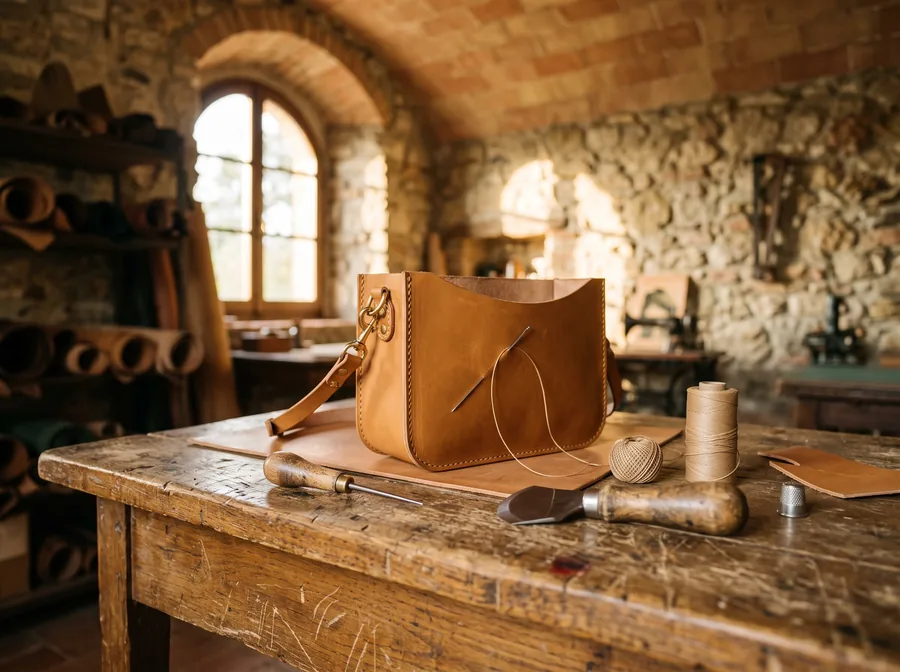
- Edges and seams: with leather it is worth looking at cleanly finished edges and even stitches. Ask where the leather comes from and where the piece was sewn.
- Origin is not method: a “Made in Italy” label says something about the place of manufacture, not about whether a piece was made by hand.
- The workshop in the room: where you can see a workbench, a kiln or a vat and someone can explain the working process, you are very likely buying directly from the maker.
Handwork takes time, and that is reflected in the price. For tableware you want to use every day, also ask about the glaze and care. Solimene, for example, states that it works with lead-free glazes and makes dishwasher-safe tableware; with smaller workshops you usually find this out only if you ask.
Visiting workshops respectfully
A workshop is a workplace, not a museum. A few habits make the visit pleasant for both sides:
- Come during opening hours and allow for a lunch break. Many small businesses close at midday for two to three hours, some completely in August.
- Ask before you photograph or film, and do not touch pieces that are drying or freshly glazed.
- Announce larger groups beforehand. The Scuola del Cuoio, for example, divides groups of more than 20 people into smaller units.
- A few words of Italian help: “Posso guardare?” means “May I watch?” and “Lo fate voi?” means “Do you make this yourselves?”
- There is no obligation to buy. But if you have received a detailed explanation, say thank you with a small purchase or a recommendation.
Shipping home
Ceramics in a suitcase are a risk, and paper or leather goods quickly make luggage heavy. Many workshops therefore ship themselves: Solimene says it exports all over the world, and the Scuola del Cuoio and the Cartiera Amatruda also sell online.
Before buying, ask whether the shop packs breakage-proof, which service it ships with and whether the consignment is insured. Ask for an invoice with an exact description and photograph the pieces before they are packed; that makes it easier to report transport damage. If you live outside the EU, for example in the UK or Switzerland, ask in the shop about the tax-free procedure and check your own country's import rules before the trip. If you visit Vietri, Amalfi and the places in between without a car, you will find the right connections in the article The Amalfi Coast without a hire car.