Chianti or Chianti Classico: two different wines
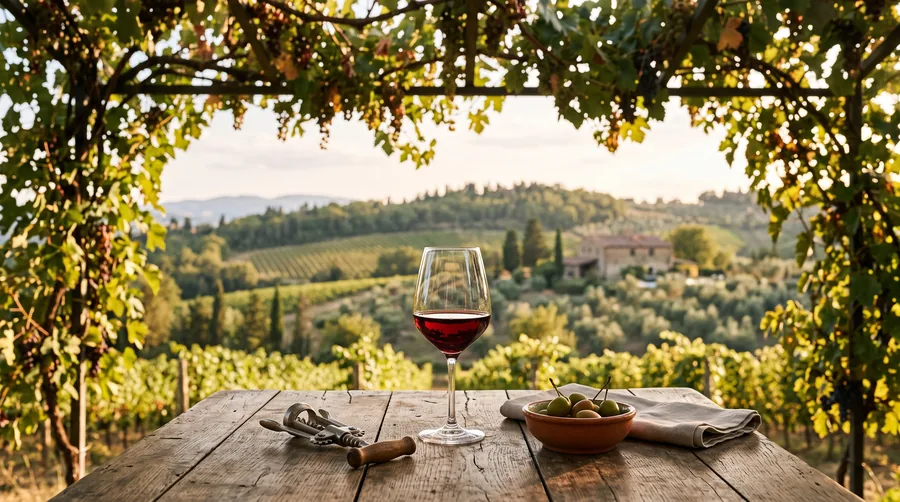
The most common confusion first: Chianti and Chianti Classico are two separate denominations of origin. Chianti Classico is the historic heartland between Florence and Siena, whose boundaries, according to the consortium, were already fixed in 1716 by Grand Duke Cosimo III de' Medici. In 1932 a ministerial decree permitted the addition “Classico” for wine from this area, in 1967 DOC status followed, and in 1984 DOCG. Since 1996 Chianti Classico has been a DOCG in its own right, and since 2010 no Chianti may be produced in its area any more.
The area covers 71,800 hectares in the provinces of Florence and Siena. The municipalities of Castellina, Gaiole, Greve and Radda in Chianti belong to it entirely, and Barberino Tavarnelle, Castelnuovo Berardenga, Poggibonsi and San Casciano Val di Pesa in part. Chianti without the addition Classico comes from a larger area around this core; there are good wines there too, but they follow rules of their own.
The black rooster: what the emblem means
The Gallo Nero is older than any wine law. According to the consortium, the Lega del Chianti, a military and political league controlled by Florence, chose a black rooster on a golden ground as its emblem in 1384. Giorgio Vasari painted it in 1565 in his Allegory of Chianti in the Palazzo Vecchio in Florence. When 33 producers joined together in Radda on 14 May 1924 to form the consortium, they adopted the rooster as their symbol.
Since 2005 the Gallo Nero has been the mark of all Chianti Classico wines and appears on every bottle; in 2013 its graphic design was revised. For you this means: a black rooster on the bottle points to Chianti Classico. If it is missing, you are holding a different wine, such as a Chianti from another area or a Tuscan country wine.
Annata, Riserva, Gran Selezione: the three tiers
The consortium describes its wines as a pyramid of three tiers. All are built on Sangiovese; the differences lie in the share of this grape variety, in the ageing time and in the origin of the grapes.
| Tier | Sangiovese | Minimum ageing | Minimum alcohol | Special feature |
|---|---|---|---|---|
| Chianti Classico (Annata) | 80 per cent | 12 months | 12% vol. | up to 20 per cent other permitted red varieties |
| Riserva | 80 per cent | 24 months, of which 3 in the bottle | 12.5% vol. | ageing twice as long as the Annata |
| Gran Selezione | 90 per cent | 30 months, of which 3 in the bottle | 13% vol. | only grapes from own vineyards, the rest only native red varieties, UGA possible on the label |
The Annata, that is the vintage wine, is the Chianti Classico for everyday and a classic companion to food. The Riserva ages twice as long and usually has more structure. The Gran Selezione stands at the top: according to the consortium it comes from a single vineyard or a selection of the estate’s best grapes and is bottled by the estate itself. The ten per cent at most alongside the Sangiovese must be native red varieties; international varieties such as Merlot or Cabernet are therefore excluded from the Gran Selezione. For Annata and Riserva they are permitted within the 20 per cent, although many producers rely on native varieties or pure Sangiovese there too.
A look back explains why. The recipe that Baron Bettino Ricasoli set down in 1872 placed Sangiovese at the centre. Since 1996, according to the consortium, a Chianti Classico may consist of 100 per cent Sangiovese; since the 2006 vintage white grapes are no longer permitted in the blend, and a minimum share of 80 per cent Sangiovese applies. Chianti Classico is thus always a red wine.
UGA: eleven place names on the label
Since an amendment to the production regulations, which the members’ assembly adopted by a large majority in June 2021, the area has been divided into eleven Unità Geografiche Aggiuntive, UGA for short. They group soils with similar characteristics and allow the name of a place to be put on the label. In a first phase this applies only to the Gran Selezione, and the indication is voluntary.
In the consortium’s geographical order, the eleven UGA are called: San Casciano, Greve, Montefioralle, Lamole, Panzano, Radda, Gaiole, Castelnuovo Berardenga, Vagliagli, Castellina and San Donato in Poggio. Some correspond to entire municipalities, others are parts of them. Important for buyers: according to the consortium, the UGA are not a quality classification, they certify the origin of the grapes. A wine from Panzano is therefore not better than one from Gaiole, but different. According to the consortium, a Gran Selezione with a UGA name may contain up to 15 per cent grapes from another UGA.
How to read the label and the wine list
In the shop and in the restaurant, four questions help:
- Does it say Chianti Classico, with a black rooster? Then the wine comes from the historic heartland.
- Which tier? Without an addition it is the Annata; otherwise Riserva or Gran Selezione is printed on the label.
- Which vintage? An Annata is good drunk young. Riserva and Gran Selezione can often take several more years; if in doubt, ask the merchant or sommelier.
- Which place? On the Gran Selezione a UGA may appear. On every label you will also find the bottler with its location, which reveals which part of the area the wine comes from.
With food, a simple rule of thumb applies: the Annata goes with pasta with tomato sauce, pizza and Tuscan cured meats, Riserva and Gran Selezione with braised dishes, game and mature pecorino. Both go well with bistecca alla fiorentina.
Tasting Chianti Classico on the spot
You learn most in the area itself, where you can compare the differences between the places directly. Greve in Chianti, Panzano, Castellina, Radda and Gaiole lie close together; the SR 222, the Chiantigiana, links Florence and Siena right across the area. Plan two to three booked visits a day, no more, and stay overnight in the area so that nobody has to drive after the tasting.
An estate that brings wine, accommodation and cuisine together in one place is the Castello di Volpaia near Radda in Chianti, which by its own account produces its wines organically. How to find a suitable wine estate with rooms is shown in the article Wine estate with overnight stay. A week with a night in Chianti is described in Tuscany in seven days, and how the aperitivo works in Italy is explained in the article Aperitivo.