Sfusato Amalfitano: a lemon with its own rulebook
If you see lemons on the Amalfi Coast, you mostly see the Sfusato Amalfitano variety. The name describes the shape: the fruit is elongated and elliptical and ends in a pronounced tip at one end. Since 2001 it has been an EU protected geographical indication (PGI, in Italian IGP) as Limone Costa d’Amalfi, registered by Regulation (EC) No 1356/2001. In 2017 the European Commission approved changes to the product specification. Since 3 October 2002, a protection consortium based in Maiori has watched over the designation.
The production rules in the 2001 version describe the fruit precisely: it weighs at least 100 grams, the peel is lemon yellow, medium thick and rich in essential oil, the flesh straw yellow and juicy, with a juice content of at least 25 per cent and high acidity. Lighter fruit with otherwise identical characteristics may go into processing, for example for liqueur or confectionery.
The growing zone covers the whole municipality of Atrani and parts of twelve other municipalities: Amalfi, Cetara, Conca dei Marini, Furore, Maiori, Minori, Positano, Praiano, Ravello, Scala, Tramonti and Vietri sul Mare. According to the consortium, around 400 hectares are farmed with the Sfusato today.
Parts of the municipality belong to the growing zone of the Limone Costa d’Amalfi, which stretches from here to Vietri sul Mare.
For the seafarers of the Republic of Amalfi, lemons were a remedy against scurvy, and as early as the 11th century ships were supposed to carry them on board. In the Valley of the Mills above the town, the Aceto family leads visitors through their organically farmed terraces with the Amalfi Lemon Experience.
The only municipality that belongs to the growing zone in its entirety. Of the twelve others, only parts are included.
Parts of the growing zone lie here too. At the Mamma Agata cooking school, the morning begins with the house lemon cake.
From here, lemons were shipped by sea to other Italian markets. In the 19th century, many families, especially in Minori, made lemon liqueur; whether Minori or Capri invented the recipe is disputed to this day.
Seat of the protection consortium, which has watched over the designation Limone Costa d’Amalfi since 3 October 2002. According to its figures, around 400 hectares are farmed with the Sfusato today.
The growing zone ends in the east with Vietri sul Mare; here, too, parts of the municipality belong to it.
Terraces, dry-stone walls and chestnut frames
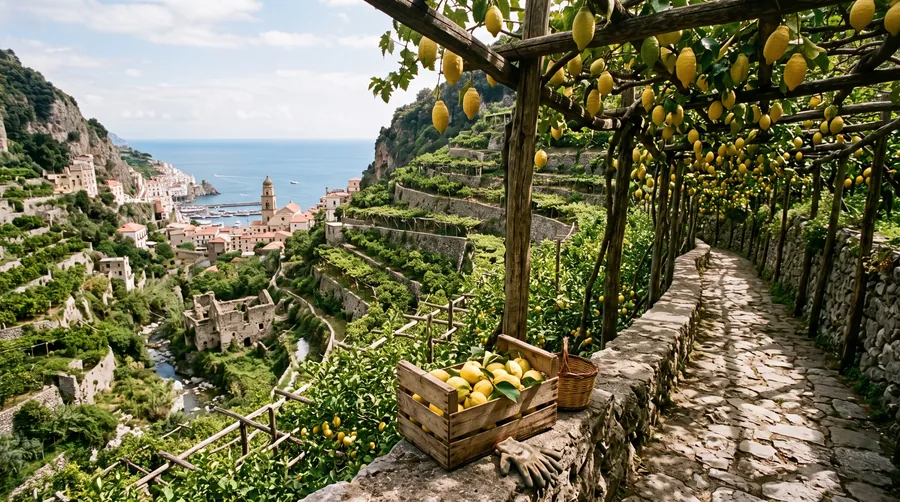
The lemon gardens of the coast, known here as giardini, lie on narrow terraces held up by dry-stone walls. In its description of the Costiera Amalfitana World Heritage Site, UNESCO highlights exactly this landscape: citrus groves, olive trees and vines on terraces bounded by walls of rough stone. The terraces make the steep slopes usable and at the same time protect them from erosion and landslides.
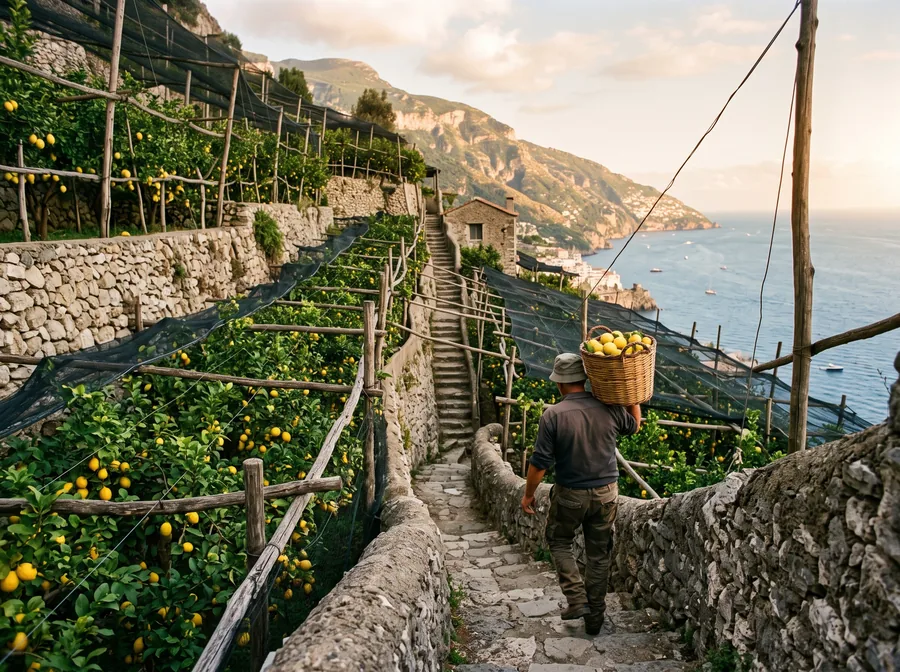
Typical is a training system called cupola locally: the trees grow as an open crown under a frame of wooden poles, according to the production rules preferably of chestnut wood and at least 180 centimetres high. Over the frames, the farmers lay covers that protect against unfavourable weather and spread the ripening of the fruit over the year. In the past these were straw mats, the pagliarelle; today they are mostly plastic nets that protect against hail and give shade.
The rules limit the density to a maximum of 800 plants per hectare and the yield to 25 tonnes per hectare. Harvesting is by hand, and the fruit must not touch the ground. Because many gardens can only be reached by steps, machines are hardly used on the terraces, and almost every step of the work remains manual.
From seafaring to export: a short history
Lemons have belonged to the coast since the Middle Ages. For the seafarers of the Republic of Amalfi, they were a remedy against scurvy; according to the technical dossier for the protected designation of the lemon liqueur, the Republic already prescribed in the 11th century that ships should carry lemons on board. From the 15th to the 19th century demand was high, including from northern Europe. From Minori, lemons were shipped by sea to other Italian markets, and in the 18th century large cargoes went as far as America.
Over the centuries the gardens grew in number and size as farmers reclaimed ever steeper slopes with walls. Today the work on the terraces is laborious, and many gardens are small. The protected designation is meant to make origin and method of cultivation visible and to distinguish the fruit from lemons grown in other regions.
Limoncello: what the protected label promises
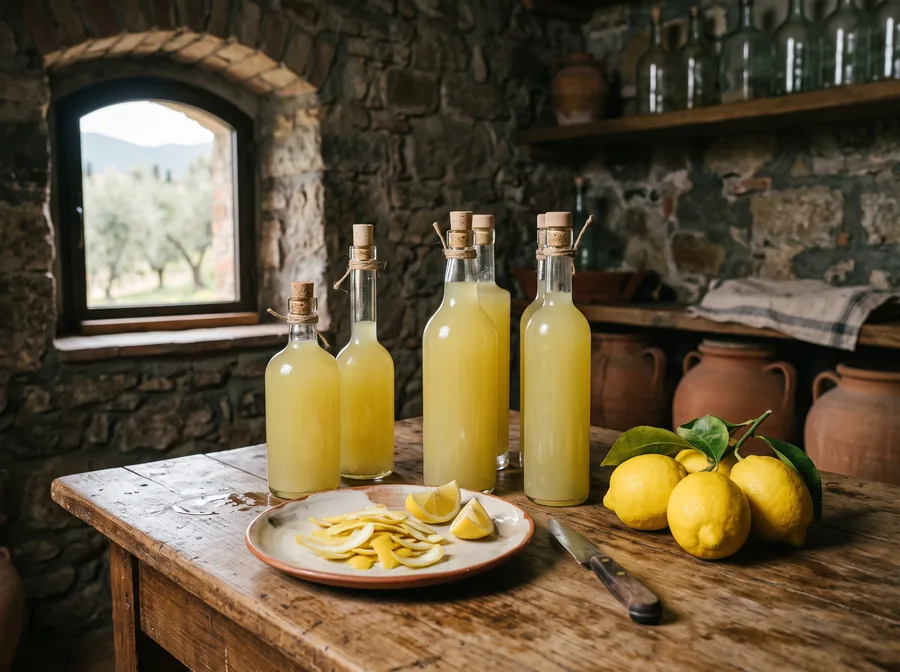
Lemon liqueur has a long tradition on the coast as a home recipe. According to the technical dossier, in the 19th century many families, especially in Minori, made a liqueur from lemons that was served after lavish meals; whether Minori or Capri invented the recipe is disputed to this day. Since 2008, the designation Liquore di Limone della Costa d’Amalfi has been protected as a geographical indication for spirit drinks. Anyone who carries this designation must meet strict requirements:
- Only the outer yellow peel (the flavedo) of lemons of the PGI Limone Costa d’Amalfi is used.
- The peels steep in alcohol, cold, for at least 36 hours.
- For every litre of liqueur, at least 250 grams of whole PGI lemons must be processed; the figure appears in the list of ingredients.
- The alcohol content is at least 25 per cent by volume, the sugar between 200 and 350 grams per litre.
- Colourings, emulsifiers, stabilisers and flavourings are prohibited.
- All steps except bottling take place in the 13 municipalities of the coast; bottling is done in glass of up to two litres.
The liqueur is cloudy to opalescent yellow and becomes clearer with time. Essential oils at the neck of the bottle count, according to the dossier, as a sign of authenticity. When shopping, the protected designation on the label is what counts: the word Limoncello alone says nothing about where the lemons come from.
Experiencing lemons: gardens, tours, cooking
The most vivid way to understand the cultivation is a visit to a lemon garden. In the Valley of the Mills above Amalfi, the Aceto family, for example, leads visitors through their organically farmed terraces with the Amalfi Lemon Experience. According to the provider, the classic tour takes about an hour and a half and includes a break with lemon cake and lemonade, a small museum of farm work and a look at how the liqueur is made. A reservation is required, and the paths have steep steps.
According to the farm, the best time for a garden visit is February to July, when the ripe fruit hangs on the trees; in the other months you mainly see small green lemons. The 2001 production rules provided for harvesting between February and October.
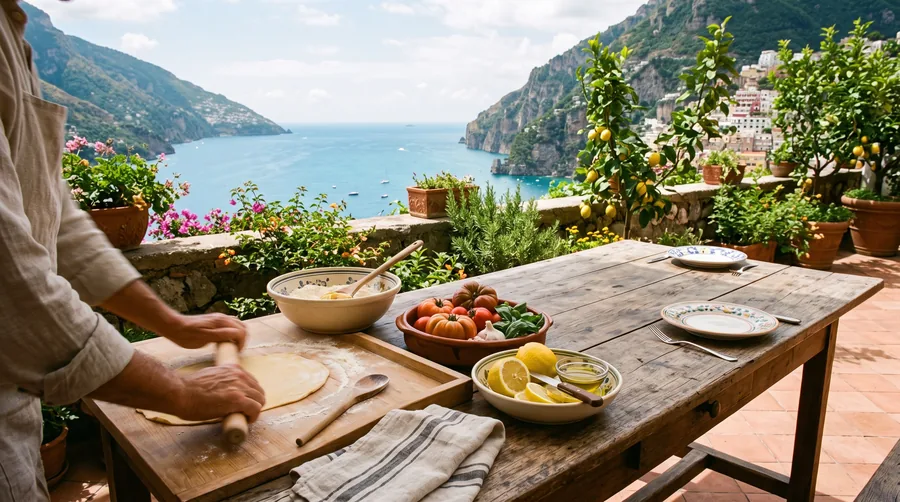
In the kitchen, the Sfusato goes into many things: in lemon cake and desserts such as the delizia al limone, in pasta with lemon or as juice over grilled fish. If you want to cook yourself, you will find the cooking school Mamma Agata in Ravello, where the morning begins with the house lemon cake. What to look for in cooking classes in general is covered in the article Cooking classes in Italy.
Buying and taking home
You recognise fresh PGI lemons by the inscription Limone Costa d’Amalfi with the addition IGP and the logo, which according to the 2001 production rules shows a lemon with a leaf next to a double circle with the profile of the coast. They are sold in fixed packs of between half a kilogram and 15 kilograms. Processed products may mention the name Costa d’Amalfi in the list of ingredients only if exclusively PGI lemons were used, the proportion is stated and processing takes place in the coastal municipalities.
Lemons make good souvenirs as long as they travel dry and well ventilated. Liqueur in hand luggage is subject to the usual airport rules for liquids; in checked baggage, bottles should be packed so they cannot break. You can read more about the region and its towns on the page Amalfi Coast.